
SAINT MARTIN Light, Summer, Wine
We all know the story of Saint Martin, but if we dig a little deeper, we discover that this Christian festival harbors an ancient pagan heart.

San Martino Cattedrale di Utrecht
The Story of Saint Martin
Every year on November 11, the feast of Saint Martin, Bishop of Tours, is celebrated in various countries. Born in Sabaria, Pannonia (present-day Hungary), he was the son of a Roman legionary who chose the name Martin in honor of Mars, the god of war. In 332, at the age of fifteen, in accordance with the decrees of Emperors Severus and Probus, he enlisted in the army and became a *circitor*—a role that involved making nightly rounds on horseback to inspect the garrisons. The most famous episode of the saint's life recounts how, one night at the gates of the city of Amiens in Gaul, he encountered a poor man shivering with cold and asking for help. He decided to cut his *chlamys* (cloak) in two with his sword and offered the lower half to the poor man. The following night, while asleep, he saw Christ—clad in that part of his cloak—saying to the angels surrounding Him: "Martin, who is still only a catechumen, has clothed Me with his garment." (A. Cattabiani, *Lunario*, pp. 364–365).
After leaving the army, he became a monk and founded a community of ascetics near Poitiers—considered the earliest datable monastery in Europe—while simultaneously carrying out intense pastoral work throughout France that brought him great renown. According to tradition, this fame led to his election as Bishop of Tours by popular acclamation. Upon his death on November 8, 397, the inhabitants of Poitiers and Tours vied for possession of his remains. His funeral took place three days later, on November 11.
Antique Origines
Gaul was the primary center from which the cult of Saint Martin spread. Christian rites did not replace Celtic rituals but instead blended with them. The Feast of Saint Martin coincides with the end of the celebrations of Samhain—the Celtic New Year and the origin of Halloween. Between October 31 and November 11, the Celts performed various rituals associated with the dead and the end of the harvest. It was a time of solemn reflection, when the veil separating the living from the dead grew thin. Winter had arrived, reminding people of the brevity of life—a life that had to be celebrated with the utmost intensity. It was a time for reunions, drinking, and feasting. During this same period, the Romans also honored the *Manes*—the souls of ancestors (on November 8)—who returned to earth and whose favor was sought. The *Manes* were of vital importance, as they protected the family; every Roman *domus* featured an altar where prayers were offered to the ancestors.
St Martin's Celebrations
St. Martin's Day was one of the most important festivals of the year—a sort of peasant New Year—marked by abundant eating and drinking. It signaled the final day before the pre-Christmas fast known as "St. Martin's Lent."
This period of merrymaking was encouraged by the completion of early autumn farm work and the milder weather that typically characterizes this time of year: "St. Martin's Summer lasts three days and a little bit more."
Another proverb states: "On St. Martin's Day, all must turns to wine." Indeed, it was the time to finish off the old wine, thereby emptying and cleaning the barrels to make room for the new vintage. At the same time, people began drinking the new wine and lighting large ritual bonfires in town squares. Goose was the traditional dish, though in humbler households, it might be replaced by duck or chicken. Legend has it that when Martin was acclaimed Bishop of Tours, he hid in the countryside, preferring to continue his monastic life. It was the honking of a flock of geese that revealed the saint's hiding place to the people of Tours, forcing him to accept the office. The custom of cooking goose also harkens back to certain pagan traditions, as the goose was once considered a sacred animal.

Pieter Bruegel il Vecchio dal titolo Il vino di San Martino
In the Veneto region, people still prepare *frittelle* for St. Martin's Day—golden, fragrant treats. In Tuscany, *cavallucci*—spiced biscuits from the Sienese tradition—are enjoyed. In Venice, children parade through the narrow streets banging on pots and ladles while reciting rhymes to get treats or coins. Across all wine-growing regions, chestnuts are roasted and bottles of new wine are uncorked.
This was also the time when agricultural contracts and rental leases expired; consequently, moving house took place during this period. The expression "faire la Saint-Martin" (to do St. Martin's) specifically meant "to move house." Furthermore, peasants were required to hand over to the lord the quantity of poultry stipulated in their land-use contracts.
In many rural areas, bonfires—symbols of purification and rebirth—are lit for St. Martin's Day, and lantern processions are organized in the Veneto to light up the darkness. In the Netherlands, children go door-to-door singing and carrying lanterns, receiving a surprise at every house they visit. In Germany, they make lanterns at school or kindergarten, gather in the streets to sing, and take part in a paper-lantern procession led by a man dressed as Saint Martin.
Signification
On St. Martin’s Day, villagers would gather around the fire to give thanks for the abundance they had received. Let us do the same! What have we harvested or received in our lives since the last harvest, before the winter rest?
This is the season of "St. Martin’s Summer"—that brief return of sunshine that warms the air once more, reminding us that even as winter draws near, the inner Light does not fade.
The shared cloak is more than just an act of charity; it symbolizes the human warmth we share as we face the bitter cold together.
Lantern to build with the children
Paper lanterns.
Materials: Pressed autumn leaves, parchment paper, cylindrical container, iron, scissors, a piece of orange or red cardstock, glue gun, hole punch, LED tea light, double-sided tape.
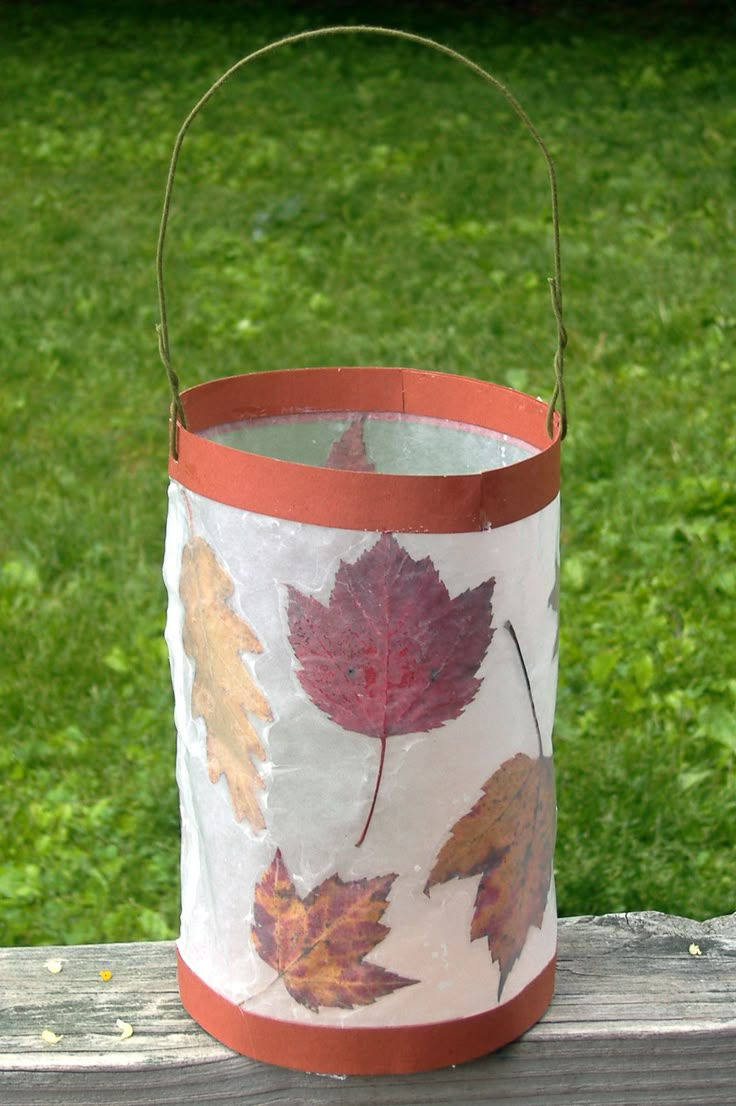
Procedure: Start by cutting off the bottom of the cylindrical container to create the lantern's base. Next, cut two pieces of parchment paper and place one on an ironing board. Arrange the pressed leaves on the paper with their most colorful side facing up. Cover the leaves with the second piece of paper and run an iron over it to fuse the two layers together. Cut two strips of colored cardstock and attach them to the top and bottom edges of the parchment paper. Attach the parchment paper to the base and wrap it around, using hot glue if necessary. Seal the lantern vertically with hot glue, working from the bottom up. Finally, punch two small holes in the top of the lantern and thread a piece of string or a length of crepe-paper-covered wire through them. If you wish to use an LED candle, place it inside the lantern you have just made.
St. Martin’s Day lanterns made from glass jars
Materials: Glass jar, pieces of colored tissue paper, PVA glue, water, paintbrush, thin wire, wooden beads, and a natural or LED candle.
Instructions: Glue the pieces of colored tissue paper onto the jar using the PVA glue. Apply another layer of glue over the tissue paper; don't worry about the white color, as it will turn transparent within a few minutes. Let it dry, then thread colored wooden beads onto a long piece of thin wire and wrap it around the jar.
Jappanese's tradiztion
While St. Martin’s Day is celebrated in the West, Niiname-sai is observed on the other side of the world, in Japan. There, our Eastern counterparts give thanks to the gods for the new rice. It is fascinating to see how, across different latitudes, human beings share the same spiritual need: to gather together, give thanks for the fruits of the earth, and preserve their inner light before the onset of the bitter cold. This is an important ceremony dating back to ancient times, during which the Emperor would offer the new grain to the gods and express gratitude for the year's harvest. Since the Meiji era, the date has been set for November 23rd, and the event has become a national rite. However, following World War II, Niiname-sai ceased to be observed, and "Labor Thanksgiving Day" was established in 1948.

In many parts of Europe and Italy (such as Venice), St. Martin's Day is a celebration for children, who go from house to house singing and banging pot lids in exchange for sweets, chestnuts, or coins. On November 15, Japan celebrates Shichi-Go-San (literally "Seven-Five-Three"). During this ancient Shinto festival, families take children aged three, five, and seven—dressed in magnificent traditional kimonos—to shrines to thank the *Kami* (gods) for their growth and to pray for health and protection during the cold months.
SOURCES:


