
Litha Alban Heruin
Updated: Apr 28
On June 21st, the longest day of the year, we celebrate Litha/Alban Heruin (literally "The Light of the Shore"), the Summer Solstice. This holiday corresponds to the Feast of Saint John for Christians. It is the celebration of rebirth and fertility. For the Celts, it does not represent the beginning of summer but the moment when summer reaches its peak. This is why Litha is often called Midsummer.

Litha is characterized by being a "day outside of time." Celebrations begin at midnight on the 20th and continue until June 23rd. The night of Litha is the time when Druids collect magical plants and dry them for use in winter. It is the ideal day for divinations and for small and large protective rites linked to the element of fire. It is said that the little people, the elves and the fairies, can be seen more easily on the night of the solstice because the veil between the worlds is thinner. Shakespeare's "A Midsummer Night's Dream" is based on this legend. During this night, very high fires salute and honor the power of the Gods, and the fruits that nature bestows on us are offered to them and crowns of ears of corn are woven to place on the head.

At the heart of the Litha celebrations are two deities: Mother Nature (Litha; a Celtic goddess related to Diana and Ceres), and Cernunnos (Horned God of Fertility). The Goddess, who in her maiden form met the young God and celebrated the sacred marriage at Beltane, is now Mother, pregnant, just as the Earth is pregnant with the coming harvest. The Mother reigns as Queen of Summer. She is the Earth; he is the energy and warmth that has entered her to give birth to new life. His energy will explode with the harvest: the grain and fruit that in the next two turns of the wheel will ripen and nourish people and animals.
Litha also celebrates love. In Scandinavia, girls would place flowers under their pillows to usher love into their dreams and make it come true. In England, it was said that if an unmarried woman on Litha set her table with a clean tablecloth, bread, cheese, and wine, then opened the door to her house and waited, the man she would marry, or his spirit, would come to celebrate with her.

The sacred plant of the summer solstice is St. John's wort, or St. John's wort. St. John's wort, picked at midday on the solstice, was said to cure many ailments, while the roots collected at midnight drove away evil spirits. St. John's wort was hung over doors to protect homes from evil spirits.
Another plant sacred to Litha is mistletoe, sacred to the Druids. It grew on the highest branches of oak trees and was cut at midday with a golden sickle. It was never allowed to touch the ground or it would lose its magic.
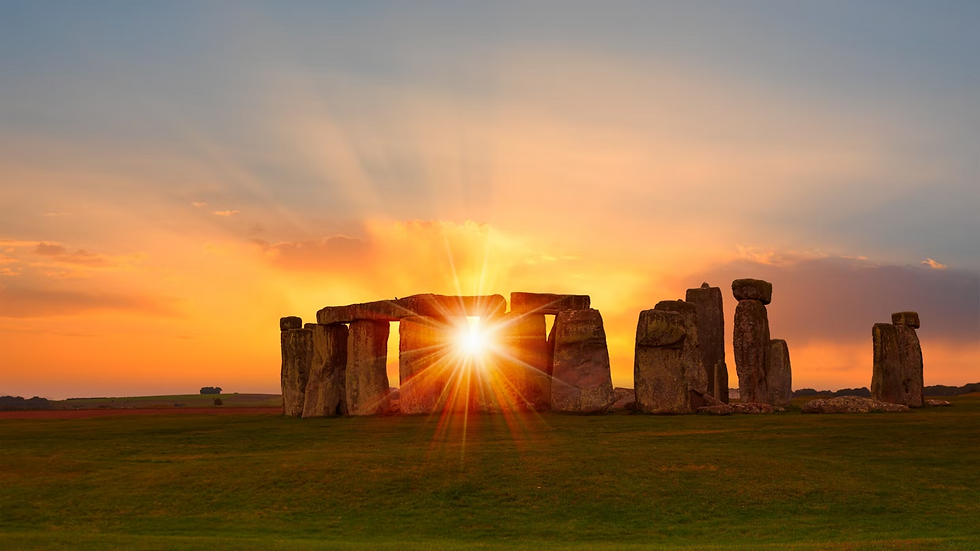
Even today, on June 21, modern neo-pagan Druids still perform grandiose Solstice rituals at Stonehenge. In 1999, British authorities allowed them to resume after a ten-year suspension decreed in 1988 for public safety reasons. As the sun at its zenith strikes the stones, it stimulates their powerful magnetic field. At the solstice, the sun rises northeast of the circle, directly behind the Heel Stone, sending the first light along the central axis of the monument.
Sources:


Comments